China Top First Aid Kit Manufacturers Near Me?
Choosing China’s top first aid kit manufacturers near me requires more than comparing prices or polished product photos. Buyers need evidence of practical experience, consistent quality, and dependable communication. A suitable manufacturer should understand workplaces, schools, vehicles, hotels, construction sites, and household emergencies. Its kits should contain clearly labeled supplies, sealed packaging, usable instructions, and replacement guidance.
Dr. Jeffrey Pellegrino, a preparedness educator, offers a useful reminder: “A first aid kit is only useful if people can find it and use it.” That principle shapes every serious search for first aid kits near me. A kit may look complete, yet fail when scissors are weak, gloves are missing, or sterile dressings have expired. Small details matter.
Reliable manufacturers should explain their quality controls, material sources, inspection procedures, and customization limits. They should also provide batch information and responsive after-sales support. Buyers can request samples before placing large orders. They can inspect zippers, labels, absorbency, package seals, and instruction clarity. Local distributors may offer faster delivery, but direct factories can provide deeper customization and stronger production visibility.
Still, no supplier is perfect. Reviews can be incomplete. Product photos can hide ordinary weaknesses. That uncertainty deserves attention, not blind confidence. A responsible comparison should examine certifications carefully and confirm whether they apply to the specific product. It should also consider emergency training, storage conditions, and replenishment costs. The best choice is not always the cheapest one. It is the manufacturer whose products remain practical when the room is crowded, the light is poor, and someone needs help quickly.
How to Identify Top First Aid Kit Manufacturers in China
Finding top first aid kit manufacturers in China requires more than comparing prices. A reliable supplier should show real production capability, trained quality staff, and clear batch records. Ask whether the factory assembles kits internally or outsources critical items. Visit the facility when possible. Clean worktables, labeled storage bins, and controlled packaging areas reveal daily discipline.
Request product samples before signing a large order. Check zipper strength, pouch stitching, seal quality, and the accuracy of every item list. Ask for material specifications, inspection reports, and certificates that match the actual products. Verify documents through independent sources, not only scanned files. Ask for evidence. A professional manufacturer should explain testing methods without avoiding technical questions.
Communication also matters. Notice how quickly the supplier reports defects, shipment delays, or missing components. A written corrective-action process shows practical experience. One weakness can still appear during sampling. I once focused too heavily on packaging and overlooked unclear expiry labeling. That mistake changed my evaluation process. Details matter. Compare sample consistency across multiple batches, review production capacity, and confirm whether the factory can maintain the same quality during peak orders. A trustworthy manufacturer welcomes reasonable audits and gives specific answers about applicable product and packaging requirements.
What First Aid Kit Products and Certifications Should You Compare?
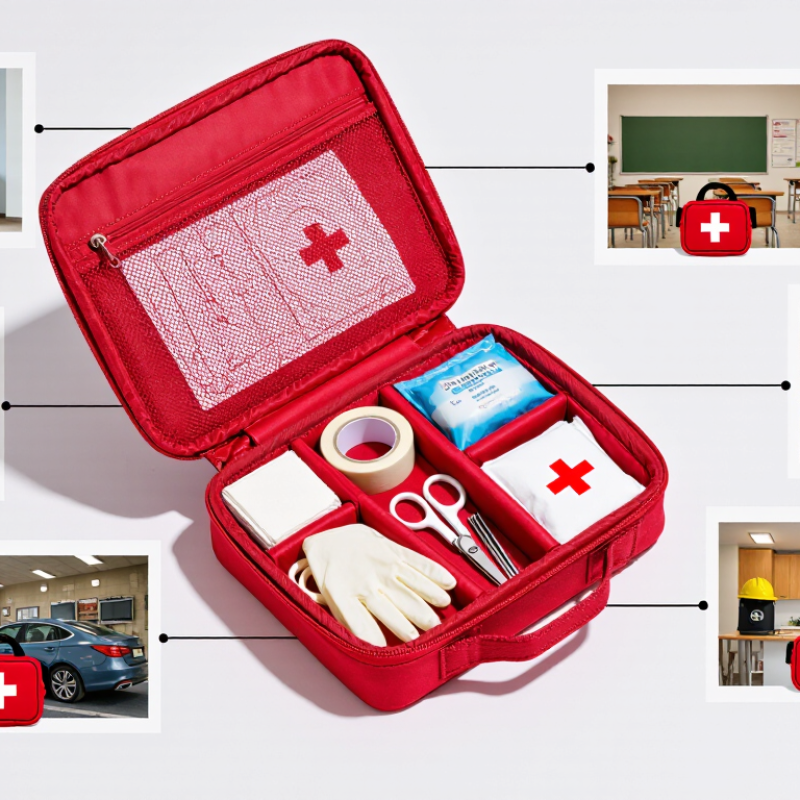
When comparing first aid kit manufacturers near you in China, inspect the product mix before discussing price. A workplace kit may need adhesive dressings, sterile gauze, gloves, scissors, eye-wash, cold packs, and an inventory card. Travel kits need lighter packaging, while burn kits require suitable sterile burn dressings. Ask for a sample. Check seal quality, readable expiry dates, lot numbers, and whether every item matches the packing list. Small discrepancies matter.
Certification claims deserve careful checking. Request the manufacturer’s quality-management certificate, such as ISO 13485. Confirm that its scope covers the supplied medical devices. For exports, verify the destination market’s conformity marking and registration rules. European requirements may involve CE documentation. United States sales may involve FDA obligations. Do not accept a logo alone. Ask for certificate numbers, issuing bodies, validity dates, declarations of conformity, and relevant test reports. Requirements differ by product and country.
I once focused too much on a low quotation and overlooked weak pouch stitching. The replacement cost was higher than expected. Now I compare material specifications, sterilization evidence, labeling, carton strength, and batch traceability. I also ask how complaints are recorded and how quickly corrective actions are handled. A reliable supplier should explain production controls without vague promises. Independent inspection can reveal missing gloves or damaged seals. My checklist is imperfect, but it exposes questions that polished catalogs often hide. Always inspect storage suitability, especially for kits kept in hot vehicles or damp rooms.
How to Verify Factory Capability and Quality Control
China Top First Aid Kit Manufacturers Near Me?
Finding a nearby supplier is convenient, but distance does not prove factory capability. A credible manufacturer should show its production areas, trained workers, and documented quality procedures. During a video tour or site visit, inspect assembly lines, storage conditions, and material separation. Look for clean shelves, labeled batches, and controlled access to finished goods.
Ask how the factory manages incoming materials, in-process checks, and final inspections. Request sample inspection records, equipment calibration dates, and batch traceability documents. For sterile or regulated components, verify applicable certifications and test reports for your target market. A reliable supplier should explain nonconforming product handling without avoiding difficult questions. One warning sign is a perfect answer to every question. Real factories usually have occasional defects and clear corrective actions.
Tips: Order samples from different production batches. Check packaging seals, printed instructions, expiry details, and component counts by hand. Ask for a written quality agreement before placing a large order. Compare the sample with the approved specification, not just photographs. I once trusted a polished showroom too quickly; the storage area later revealed weak humidity control. That mistake was avoidable. Regular communication, independent inspection, and realistic lead-time discussions provide stronger evidence than sales promises.
How to Assess Pricing, Minimum Orders, and Customization Options
When searching for China first aid kit manufacturers near me, compare more than the quoted unit price. Grand View Research reported that the global first aid kit market was valued at approximately USD 1.6 billion in 2023, with steady growth expected through 2030. This demand can support competitive pricing, but low quotes may exclude inspection, freight, duties, or printed packaging. Ask for landed cost.
Standard soft-case kits: Supplier quotations often fall between USD 2 and USD 8 per unit, depending on contents and order volume.
Rigid cases, workplace configurations, and added instruments: These may cost USD 10 to USD 30.
These are practical sourcing ranges, not fixed market rules. Minimum orders commonly start around 100 to 500 units.
Some factories accept smaller trial orders, but the unit price usually rises. Samples reveal gaps.
Assess Customization Line by Line
Customization should be assessed line by line. Request separate prices for logo printing, fabric colors, molded cases, instruction cards, and component changes. A new mold can add hundreds or thousands of dollars, while simple label changes may cost much less.
The International Organization for Standardization’s ISO 13485 framework emphasizes controlled quality systems for medical devices, so ask about batch records, incoming inspection, and final inspection. Supplier documents can look impressive. Verify them.
I would also request a pre-production sample and photograph the packed kit before approval, because one overlooked component can distort the entire comparison.
How to Choose a Reliable Manufacturer Near Your Market
Searching for “China top first aid kit manufacturers near me” is only the beginning. Distance does not prove reliability. According to Grand View Research, the global first aid kit market was valued at about USD 1.5 billion in 2023. It is projected to grow steadily through 2030. This growth attracts new suppliers, including factories with limited quality controls.
Choose a manufacturer with experience in your target market. Ask for recent audit records, product samples, batch traceability, and documented inspection procedures. ISO 13485 certification can indicate a structured medical-device quality system, but it is not a complete guarantee. Verify the certificate with the issuing body. Request evidence for adhesive strength, sterile packaging, material safety, and shelf-life testing. Small details matter. A loose bandage or unclear label can damage customer trust.
Location still affects service. A factory near major Chinese ports may reduce shipping delays and simplify pre-shipment inspections. However, local inventory or a regional warehouse may matter more than factory distance. The World Health Organization emphasizes quality, safety, and availability across health-product supply chains. Apply that principle during supplier evaluation. Speak with the quality manager, not only a salesperson. Visit the facility when possible. I would also order a pilot batch before signing a large contract. It costs more initially, yet it reveals packing errors, inconsistent quantities, and weak communication. Some buyers ignore these warning signs. That is a costly mistake.